Creativity in Negative Space
AI excels in positive space, where culture already drew the map. Human creativity lives in negative space: the gap nobody has named yet.



Ask an LLM what you conveniently left out of a strategy memo, and the answer can feel unnervingly perceptive.
That looks like a paradox if you believe, as I argued last week in Creativity in Negative Space, that LLMs operate entirely in positive space (everything humans have already written and absorbed into training data), while real creative breakthroughs live in negative space (the gap nobody has named yet).
My friend Jordan Rubin read that post and pushed back in a comment on my Substack:
“I agree with you that creativity works differently in positive and negative space. I don’t agree that AI can’t see the negative space. It can! It just needs to be prompted to.”
He linked an earlier post from his own Substack, What do you have unsaid?, where he introduced a prompt skill called negspace. Run negspace on a strategy memo or blog post, and it surfaces hidden motives, strategic omissions, unstated assumptions, and blind spots. As Jordan puts it, the reaction is “uncanny. Not in the uncanny valley sense, all too common with LLMs, but in the how did it know sense.”
On closer look, Jordan’s article and prompt reinforce exactly the point I’ve been making. Jordan and I were using “negative space” at two different levels: what is missing inside an individual document versus what is missing outside the training corpus. As his own spec makes clear, negspace works because a model’s positive space acts as a collective mirror for our individual blind spots.
Jordan’s negspace specification describes the mechanism plainly:
detect the argument, conclusion, or premise that should be present given the statistical structure of the text, but is conspicuously absent. negspace reads the “shadow” of the text by comparing what was written to what was overwhelmingly likely to be written next…
Overwhelmingly likely to be written next. Later in the spec, Jordan puts a rough number on it, asking the model to find the omitted conclusion “~80–95% likely given the argument’s structure,” or “the statistical ghost of the missing argument.”
In his spec, Jordan uses “perplexity spike” and “~80–95% likely” as prompting heuristics, not literal logprob readouts. A chat prompt doesn’t inspect its own token probabilities, and if you instruct an LLM to hunt for hidden motives, it will gladly hallucinate cynical ones for any paragraph you hand it. What makes the useful hits land is pattern completion, drawn straight from the densest positive space in the model’s weights.
An LLM has ingested millions of essays, arguments, post-mortems, and negotiations, giving it an aggregate map of how human arguments unfold. When an author swerves off that expected path, whether from ego protection or a genuine blind spot, a prompt asking “what argument usually follows this setup?” completes the half-finished template.
To the author, that omission felt private or justified. To the model’s weights, the missing piece is a well-lit highway the author just drove off of.

What feels private inside an author’s head looks to the model’s weights like driving straight off a well-lit highway.
What makes a routine pattern completion feel like mind-reading is that we hide those detours from ourselves first.
That effect gets sharpest whenever a technical choice hardens into professional identity. In Why Engineers Can’t Be Rational About Programming Languages, I wrote about why language debates behave more like tribal arguments than benchmarks. In a 2016 fMRI study on political beliefs (the closest well-studied analogue to identity-fused convictions), Kaplan, Gimbel, and Harris found that challenging strongly held political views, unlike non-political facts, increased activity in the default mode network (tied to self-identity), with greater insula and amygdala activity in people who resisted changing their minds. As Jonas Kaplan put it, “To consider an alternative view, you would have to consider an alternative version of yourself.”
So we protect ourselves. We skip the inconvenient counterargument and gloss over the dual-use risk. We leave an escape hatch in our phrasing so we stay uncommitted if things go sideways. From inside our own heads, those omissions disappear into personal blind spots.
To counter my own blind spots, I leaned on that collective mirror while building The 9 Cost Factors (and I’ll share the results across major languages soon). After years on the Go team at Google and maintaining Go tools, my bias toward Go is unquestionable. Left to myself, I over-index on what Go does well and at times rationalize away its friction. Running the nine economic factors through multiple LLMs let me pit the industry’s collective bias against my individual bias, surfacing trade-offs I would have edited out.
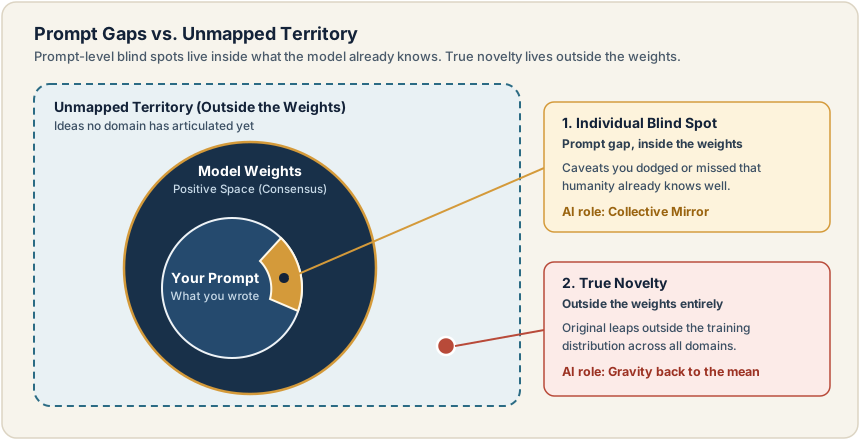
Two different boundaries: prompt-level omissions sit inside the model’s weights, while true novelty sits outside them.
Individual blind spots are negative space in the prompt, sitting squarely inside positive space in the weights. They are the things you missed or dodged that humanity already knows well enough for a model to predict. Projecting that statistical consensus onto your context window turns the model into a collective mirror for subtext and identity bias.
True novelty is negative space in the weights. These are the unmapped ideas and intuitions nobody has articulated yet, outside the training distribution. Here, the model’s positive space stops acting like a mirror and pulls you back toward consensus.
One caveat matters here: the weights aren’t a single monolithic consensus. Because a model absorbed many disciplines at once, it can still expose an industry blind spot by importing a familiar pattern from an adjacent field. Cross-domain synthesis still sits inside positive space in the weights, even when your own community missed it. True negative space in the weights is rarer: an idea none of those domains have articulated yet.
The same mechanism that makes negspace work is why AI struggles to originate breakthroughs. Reading a text’s shadow works because the model strongly expects what should come next. Breakthrough creativity happens when a human writes something with near-zero probability that isn’t a missing step from an old template.
Start in positive space. Run a prompt like negspace, or pit multiple models against your argument, before you ship a draft or commit to an architecture. Let the collective memory in the weights show you where you’re hedging and where your identity bent the framing.
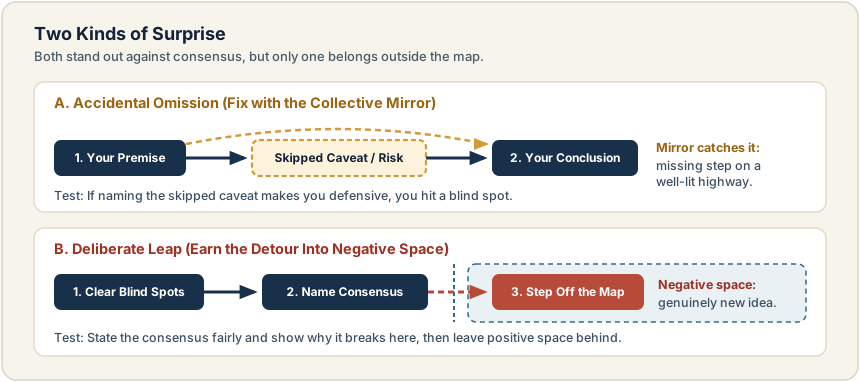
Two kinds of surprise: skipping a standard step vs. stepping off the edge of the map.
Keep the mirror’s limit in view. Because the weights reflect collective consensus rather than truth, a model catches your personal blind spots fast and still misses gaps shared across the entire training corpus. Obey every omission it flags, and you’ll sand off what made your argument worth making.
How do you tell an accidental omission from a deliberate leap when your own ego is an unreliable judge? Test whether you can state the missing premise out loud and argue against it fairly. If the critique makes you want to hide the caveat, you hit a blind spot. If you can name the consensus view cleanly and show why it breaks here, you’ve earned the detour.
When your work surprises the model because you have something genuinely new to say, rather than something you forgot to admit, you’ve left positive space behind.

AI excels in positive space, where culture already drew the map. Human creativity lives in negative space: the gap nobody has named yet.

Open source maintenance is breaking at scale. Can AI code review can help maintainers without breaking trust, judgment, or community.